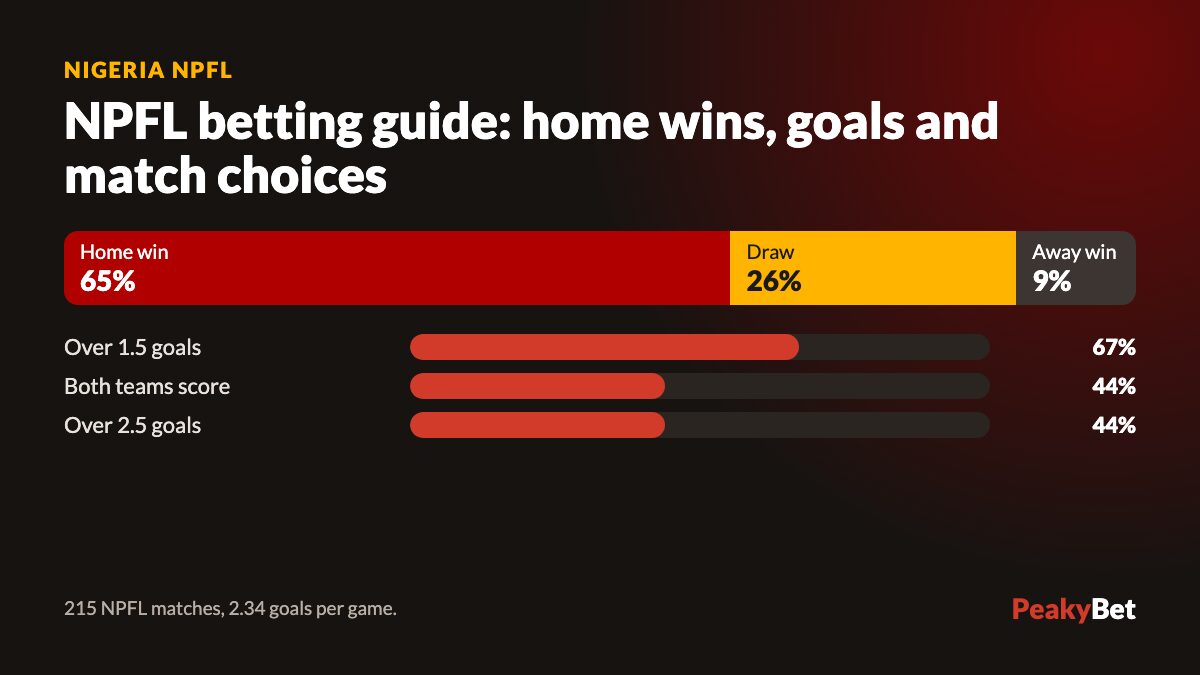
The NPFL betting picture in PeakyBet’s sample is strongly tilted towards home wins: 65% of 215 completed matches ended with the hosts winning, while away wins were 9%. Use that as a starting point for match research. It supports checking home strength carefully, but it does not make every home team a sensible bet.
Read the Nigeria NPFL figures together
These figures cover completed Nigeria NPFL matches in PeakyBet’s last 365 days of data. They describe the recorded sample, rather than every future fixture. Read the outcome rates alongside the goal rates. A league can favour home wins while still producing a mix of narrow wins, draws and games with more goals.
| Measure | Recorded figure |
|---|---|
| Matches | 215 |
| Home wins | 65% |
| Draws | 26% |
| Away wins | 9% |
| Average goals | 2.34 |
| Over 2.5 goals | 44% |
| Both teams to score | 44% |
The table gives you a useful base for asking questions. It does not explain why the results occurred. Avoid inventing reasons such as travel, refereeing or crowd effects from these figures alone. Those claims would need separate evidence. Stay with what the sample actually shows: home wins were common and away wins were less common.
Use the home rate to guide your first check
A 65% home-win rate makes the hosts worth close attention when you begin reviewing an NPFL fixture. Check whether the particular home side fits the wider pattern. A weak home attack or a strong visiting defence can change the picture. League context should help organise your research, rather than replace the team-level assessment.
The Nigeria NPFL match page is a starting point for reviewing the competition. Compare the teams involved before deciding on a market. If you cannot explain why this home side should win against this visitor, the league rate alone is not a complete reason to place the selection.
Keep draws in the match-result decision
Draws account for 26% of the NPFL sample. This matters when a home favourite looks strong but has trouble turning pressure into goals. A home-win bet still loses when the match finishes level. The low away-win rate should not make you forget that a draw is a separate possible result.
Think about the way the match could stay close. You may expect the hosts to avoid defeat without expecting them to win clearly. That difference should influence which market you study. It can also be a reason to skip the game if the available prices do not match your view of the uncertainty.
Treat rare away wins as possible outcomes
Away wins occurred in 9% of the recorded NPFL matches. That is a historical share, not a statement that every visiting team has the same chance. Some visitors will be stronger than others. Some hosts will be weaker. An unusual league outcome can still be the most reasonable outcome for a particular matchup.
Do not pick an away side only because its price looks large. Equally, do not dismiss it only because of the league average. Ask whether the team evidence supports the selection and whether the odds are worth the risk. A long price does not create value by itself, just as a short home price does not prove safety.
Separate total goals from both teams scoring
The NPFL sample averages 2.34 goals per match. Over 2.5 goals occurred in 44%, and both teams to score also occurred in 44%. The equal percentages do not make these markets identical. The totals market asks about the combined score. Both teams to score asks whether each side scores at least once.
A match can have plenty of goals from the hosts while the visitors fail to score. Another can have goals from both teams without passing the over 2.5 line. Before choosing between these markets, decide whether your view depends on a strong attack from a single side or on attacking chances for both teams. The distinction changes what must happen for your selection to win.
Compare a home-win forecast with its price
Use the home team to win predictions to explore match-level ideas. PeakyBet’s Poisson model uses expected goals from season averages and the latest 5 matches. Its view is blended 50/50 with bookmaker odds after the margin is removed. This creates an estimate, not a promise about the result.
The odds still matter after you find a likely home winner. A price may already reflect the league’s home pattern and the team’s strength. Record why you think the selection is worth considering at the price shown. If your whole argument is that home teams often win in the NPFL, return to the fixture and look more closely.
Set an NPFL budget before choosing fixtures
Betting is for adults aged 18+ only. Use only money you can afford to lose, and keep essential spending separate. A strong historical home trend does not justify a stake that would hurt you if it lost. Stop if you feel pressure to recover money from earlier results.
Keep brief notes on your reasoning and review both winning and losing selections. Look for habits such as overlooking draws or using league averages without checking the teams. You do not have to bet on every NPFL fixture. Clear limits and honest records are more useful than trying to force a pick from every match.
Frequently asked questions
Can I compare this sample with a season table?
Yes, but check the coverage first. A season table and a rolling period of completed matches may include different fixtures, so their totals and rates may not match directly.
Does the league average show how every club plays?
No. A league average combines different clubs and fixtures. Use it for context, then examine the teams involved before drawing conclusions about a particular club’s likely performance.
Should I increase my stake after several good NPFL picks?
No automatic increase is justified by a short winning run. Keep any decision within your planned budget, and review the quality of your reasoning as carefully as the results.