A 5-odds accumulator combines selections whose decimal odds multiply to a total of at least 5.00. Every leg must win for a normal winning slip. More legs add more ways to lose. PeakyBet builds its slip from odds of 1.20–2.20, stopping when the total reaches at least 5.00, with a maximum of 6 legs.
Understand the total price before placing the slip
An accumulator joins separate selections into a combined bet. The decimal prices are multiplied to produce the total odds. For a winning slip, the total decimal price gives the gross return as a multiple of the stake, including the original stake. It is not the profit alone. Read the potential return shown before confirming the entry.
The phrase 5-odds describes the combined price, not the number of matches. A slip can reach that target with different combinations of selections. Adding a match changes both the total odds and the conditions needed to win. Do not judge a slip only by the return displayed at the bottom of the screen.
See how the PeakyBet accumulator is assembled
The 5-odds accumulator for today combines picks priced from 1.20 to 2.20 until the total reaches at least 5.00. It uses no more than 6 legs. These rules describe the slip’s construction. They do not state a win rate or prove that any particular combination offers good value.
Review each selection in the suggested slip. Check the teams, market and odds before deciding whether the reason for that leg is clear. A total-price target can organise a list, but the target itself does not improve the underlying matches. A questionable selection remains questionable even if it helps the total reach the required level.
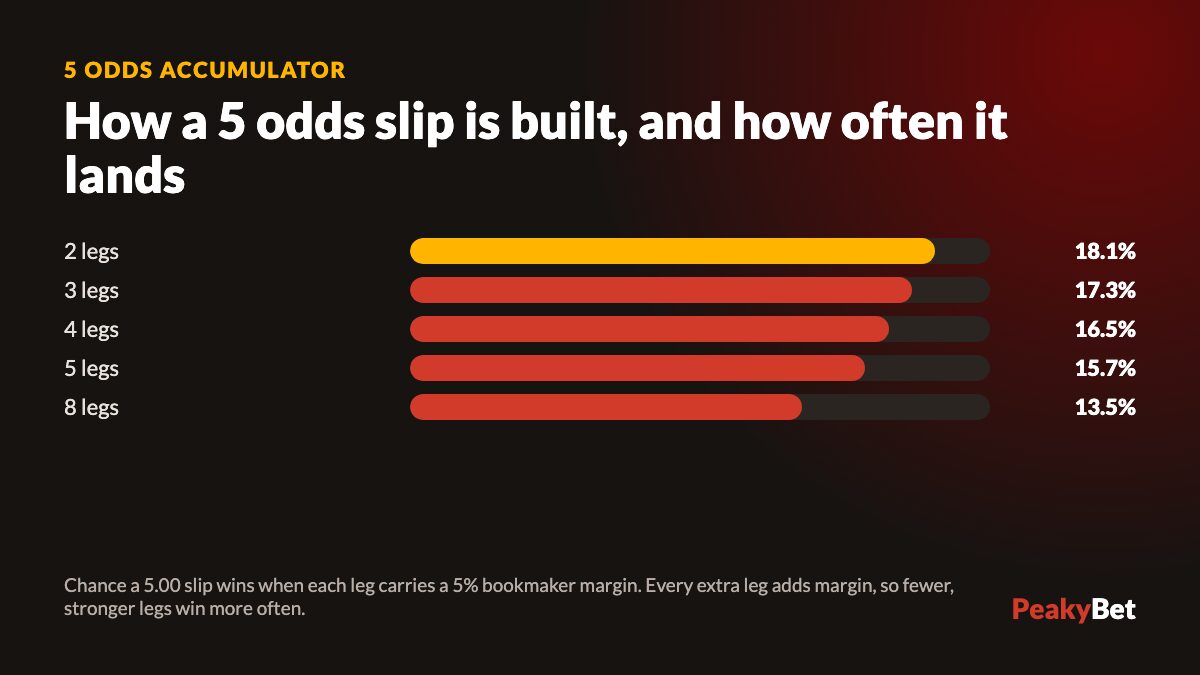
Understand why an extra leg adds risk
Each normal accumulator leg is a condition that must succeed. If a required selection loses, the slip loses. A favourite with short odds can still fail, and that failure can cancel the benefit of all the correct picks elsewhere. The risk comes from needing the entire set of selections to work together.
When selections are independent, their win probabilities multiply. If selections are linked, the calculation needs extra care because the outcomes can affect each other. Either way, a list of likely individual picks should not be read as an equally likely combined result. A high confidence level for a leg is not the confidence level for the whole slip.
Review the weakest selection on its own
Read through the slip and identify the leg you understand least. Ask whether you would consider that selection separately at the price offered. If the only reason to include it is to reach the total odds, you may be forcing a bet. Removing a weak selection can leave a lower-priced slip, which is a valid outcome.
The accumulator tips can support your review, but you should still know what every market requires. A result market, a goals market and a both-teams-to-score market have different winning conditions. Familiar team names do not replace reading the labels. Check the full slip carefully on your phone before placing it.
Keep estimated probabilities separate from results
PeakyBet’s model uses Poisson expected goals based on season averages and the latest 5 matches. It blends that view 50/50 with bookmaker odds after removing the margin. These inputs help estimate outcomes. They do not remove surprise results or mean that the accumulator’s total odds describe its true chance of winning.
Every PeakyBet tip is automatically graded as won or lost, with results public in the accuracy report. Use the record to examine the history of tips. Do not treat individual winning picks as proof that a combined slip won. Review the exact selections together when assessing an accumulator, since every required leg affects the final outcome.
Check changed prices and settlement terms
The prices you see when placing a slip may differ from an earlier suggestion. Recheck the total after entering all the selections. A price change can alter the potential return and may affect whether the bet still fits your judgement. The total odds are a price to assess, not a target you must restore by adding another fixture.
Read the rules for postponed, abandoned or void selections before placing the accumulator. Settlement terms can affect how a slip is handled and what total price remains. Avoid assuming that every unusual match event has the same result. Keep the accepted slip details so you can compare the settlement with the conditions you agreed to.
Set the stake independently of the possible payout
Betting is for adults aged 18+ only. Use only money you can afford to lose. Decide the stake from your available entertainment budget before considering the possible return. Keep rent, food, transport and other essential spending separate. If losing the stake would create a problem, do not place the slip.
Do not raise your stake to recover a failed accumulator or add more legs because the payout looks small. A narrow miss still loses under the normal winning conditions. Record the full stake and actual return honestly. Taking a break or choosing no bet is sensible when the slip feels unclear or the result starts to affect your mood.
Frequently asked questions
Does a bigger combined price mean better value?
No. A bigger price can simply reflect a less likely set of outcomes. Value depends on the price relative to the chance of success, not the payout alone.
Should I count a cash-out offer as the full possible return?
No. A cash-out offer is a separate amount that may differ from the return shown for a fully winning slip. Availability and terms depend on the betting service.
Can I judge my approach from a single accumulator?
No. A single result gives little evidence about your decision process. Review your reasons and keep honest records over time, while remembering that past outcomes do not determine future results.