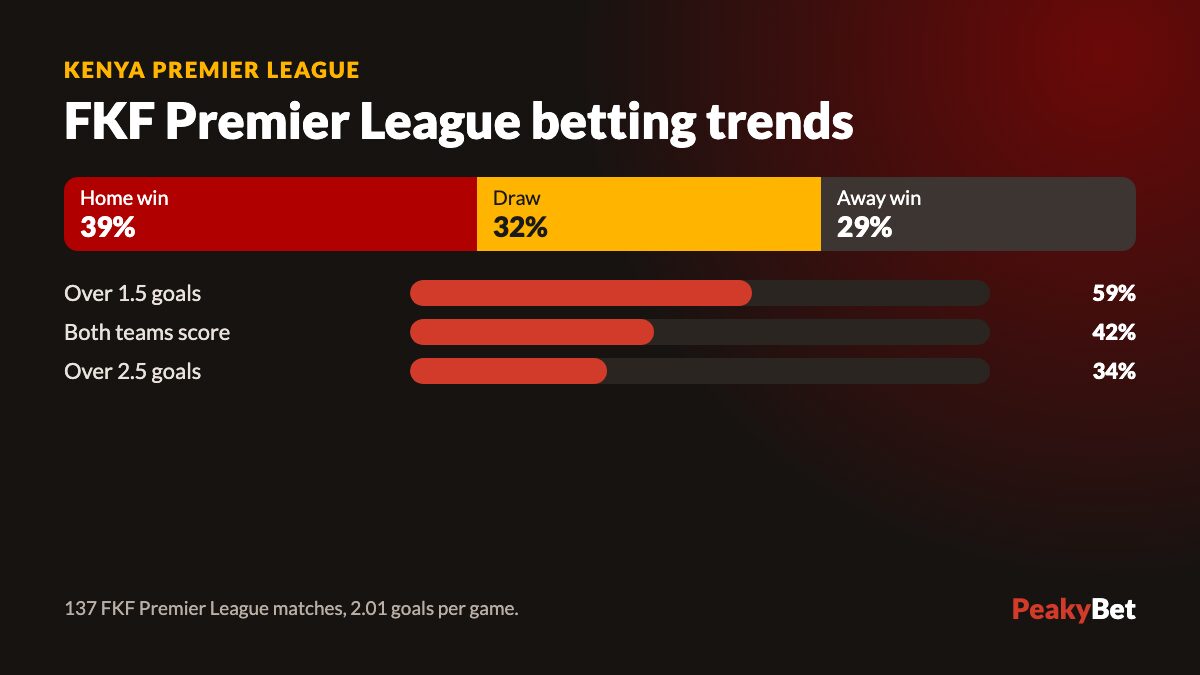
Kenya Premier League betting trends in PeakyBet’s sample point to a lower-scoring competition than the England Premier League. Kenya averages 2.01 goals, with draws in 32% of matches. Use those patterns to study totals and close games, while checking the teams and the odds before making a selection.
Compare Kenya FKF Premier League with the EPL
The table uses completed matches from PeakyBet’s last 365 days of data. Kenya FKF Premier League has 137 matches in this sample, while England Premier League has 194. These are different collections of fixtures. The comparison describes the recorded competitions and does not prove how any future match will finish.
| Measure | Kenya FKF Premier League | England Premier League |
|---|---|---|
| Matches | 137 | 194 |
| Average goals | 2.01 | 2.71 |
| Over 2.5 goals | 34% | 54% |
| Both teams to score | 42% | 54% |
| Home wins | 39% | 39% |
| Draws | 32% | 30% |
| Away wins | 29% | 31% |
The goal figures show a clearer contrast than the draw figures. Kenya’s average is 2.01 goals, compared with 2.71 in the EPL. Kenya’s draw share is 32%, compared with 30% in England. Avoid turning that small draw difference into an extreme claim about either competition.
Use the lower goal average as context
A lower average suggests that high-scoring expectations deserve a careful check. It does not mean that every Kenyan fixture will be quiet. A league average combines attacking games, tight games and everything between them. The particular teams can differ from that pattern, especially when their strengths and weaknesses suit an open contest.
Start with the Kenya FKF Premier League fixtures. Ask how each side’s scoring record fits the league context. Do the teams support a low total, or are you relying only on the competition name? Keep recent results beside the wider record so a memorable game does not dominate your judgement.
Study the draw without making it the default
Draws occurred in 32% of the Kenyan sample. That makes them worth serious attention, especially where neither side looks clearly stronger. Yet a draw is still a specific result. A close match can finish with a narrow winner. Low scoring and a draw are related ideas you might investigate, but they are not the same prediction.
The draw predictions can help you review possible level finishes. Look for reasons on both sides of the fixture. Balanced attacking expectations may support a close game, but you still need to consider the price. A match that looks even is not automatically worth backing to end level at any odds.
Read the over 2.5 rate alongside the teams
Over 2.5 goals occurred in 34% of Kenya’s recorded matches, compared with 54% in the EPL sample. This gives a useful warning against carrying English league expectations straight into Kenyan football. The same goals market can face a different historical background across the competitions. Your starting assumptions should reflect that difference.
Use the over and under 2.5 goals tips as a further match-level check. A lower league rate can support looking at under selections, but it does not settle the price question. If the available odds already strongly reflect a quiet match, the selection may offer little reward for the risk.
Keep BTTS separate from the total-goals view
Both teams scored in 42% of the Kenya sample, compared with 54% in England. This market asks a different question from over 2.5 goals. You need each team to contribute a goal. A strong attacking performance from the favourite alone is not enough for a both-teams-to-score selection to succeed.
Check whether your match argument relies on a goal from a weak attacking side. A game can produce a high total without both teams scoring, or finish with both teams scoring while staying below the over 2.5 line. Treat the equal EPL percentages as a feature of this sample, not as proof that the markets are interchangeable.
Avoid copying a home-win assumption across leagues
The Kenyan sample has home wins at 39% and away wins at 29%. The EPL sample also has home wins at 39%, with away wins at 31%. Matching home-win shares do not mean the competitions have the same goal patterns or that individual teams carry the same risks. The other columns show why several measures matter.
When you review a fixture, write down the market you are actually considering. Then identify the relevant evidence. A total-goals argument needs scoring evidence. A home-win argument needs a view of both teams’ chances of winning. Keeping those questions separate helps prevent a general league impression from becoming a reason for every possible bet.
Keep local football betting affordable
Betting is for adults aged 18+ only. Use only money you can afford to lose. Familiarity with Kenyan football does not remove uncertainty, and support for a club can make a match harder to judge calmly. Keep your spending limit clear before you look at the fixtures.
Record the reason for a pick before kick-off, then review it after settlement. Notice whether you used the relevant data or simply expected another low-scoring game. If the evidence is mixed or you feel pressure to win back money, take a break. You can follow the league and enjoy the football without placing a bet.
Frequently asked questions
Does this dataset prove why Kenyan matches have fewer goals?
No. It shows recorded outcomes, not their causes. Explaining the pattern would require further evidence about the matches, so avoid treating guesses about playing style as established facts.
Can I use this table for a live match?
Use it only as background. A live game has its own score, time remaining and match events, which the historical table does not describe or adjust for.
Should club loyalty affect my selection?
Club loyalty should not stand in for evidence. If supporting a side makes it difficult to assess its weaknesses, consider leaving that fixture out of your betting decisions.