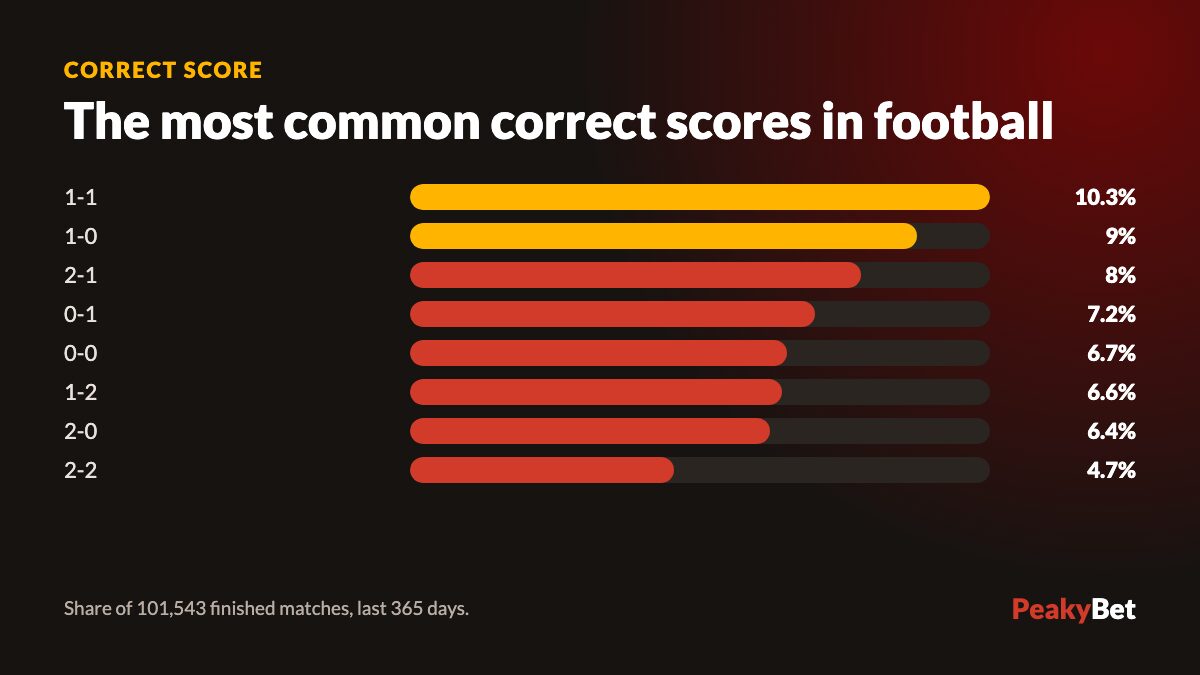
The most common correct score in PeakyBet’s completed-match dataset is 1-1, at 10.3%. That still makes it a narrow outcome. Use common scores to understand the range of possible results, then assess the individual fixture. The most frequent score across many leagues is not automatically the best pick for every game.
Compare the leading scores in the recorded sample
The table covers 101543 completed matches from the last 365 days in PeakyBet’s data. Scores are written with the home team first. Each percentage is the share of that recorded sample ending with the listed score. These figures describe the past; they do not show the chance of a score in the next match.
| Correct score | Share of matches |
|---|---|
| 1-1 | 10.3% |
| 1-0 | 9% |
| 2-1 | 8% |
| 0-1 | 7.2% |
| 0-0 | 6.7% |
| 1-2 | 6.6% |
| 2-0 | 6.4% |
| 2-2 | 4.7% |
| 0-2 | 4.6% |
| 3-1 | 4.1% |
The leading entries include draws, home wins and away wins. This spread is useful. It shows that there is no single score around which all football results gather. Even familiar scores account for a limited part of the sample. Keep the full range in mind when a prediction page highlights a leading result.
Separate a match result from an exact score
A home-win forecast can succeed through many different scorelines. A correct-score selection needs the home and away goal totals to match the selected result exactly. You can be right about which team is stronger and still lose the score bet. You can also read the likely pace of the game well and miss the final totals.
This is why a convincing story is not enough. A strong home side may win narrowly or score freely. A defensive match can end level or turn on a late goal. Each path creates a different final score. Ask how many nearby results would break your selection before you decide whether the price is worth considering.
Understand how Poisson ranks possible scores
A Poisson model starts with an expected goal estimate for each side. It uses that estimate to assign chances to possible goal totals. Combining the home and away goal probabilities creates a table of potential scores. The model can then rank those scores, showing which combinations look more likely under its assumptions.
Expected goals are averages used by the model, not a promise that a team will score a particular amount. A leading cell in the score table may sit only slightly above nearby cells. Treat the ranking as a guide to relative likelihood. It does not mean the top score has a large chance of happening on its own.
Know which inputs shape the PeakyBet forecast
PeakyBet builds expected goals from season averages and the latest 5 matches. Its Poisson model view is blended 50/50 with bookmaker odds after removing the margin. The season view offers a broader base, while recent games add a shorter view. The market adds another signal, but it can still be wrong.
Look at the correct score predictions for today with those limits in mind. A model cannot turn a close group of scores into certainty. A match can also develop in ways that its earlier data does not capture well. The forecast should support your judgement, especially when the possible outcomes appear tightly grouped.
Apply league context before using a popular score
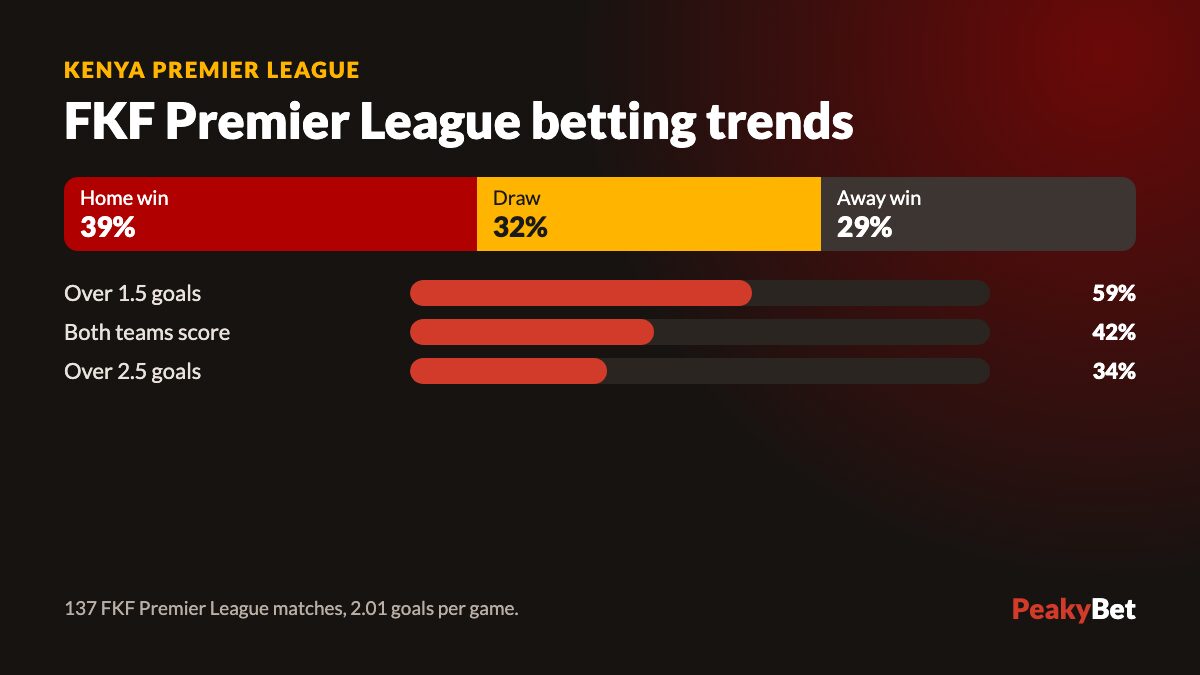
The mixed dataset combines competitions with different scoring patterns. Nigeria NPFL averages 2.34 goals in the supplied sample, while Kenya FKF Premier League averages 2.01. Those averages do not tell you the exact score. They do show why a broad score table needs local context before you use it for an individual fixture.
Look at the teams as well as their league. Ask whether the home and away scoring records support the same match picture. Be careful when a brief run of results becomes your whole argument. A team can produce a high-scoring game without becoming a high-scoring team in every future match. Keep recent form beside the wider season view.
Use a shortlist without chasing every outcome
Writing down nearby possible scores can reveal how uncertain your main pick is. It does not mean you should bet on all of them. Buying more selections increases the total amount at risk. Check that total before placing anything, and avoid treating extra picks as a free way to improve your chances.
The correct score predictions for tomorrow can help you prepare a review ahead of the fixtures. Recheck the match and market details when you return. Keep a record of the score you considered and the reason behind it. After the match, compare the actual result with the wider range you expected, not just your chosen score.
Keep exact-score stakes within your limits
Correct-score betting is for adults aged 18+ only. Use only money you can afford to lose. A large possible return can distract from the narrow winning condition. Decide your spending limit before looking at payouts, and never increase it to recover earlier losses.
Passing on a match is sensible when several scores look equally plausible or the available odds do not appeal. Your aim is to understand the uncertainty. There is no need to turn every model ranking into a bet, and a popular historical score is never a substitute for a clear decision.
Frequently asked questions
Does a score become due after a long absence?
No. An absent score is not owed to future matches. Assess the current fixture on its own evidence instead of assuming that past results must balance out soon.
Can a correct-score price change before kick-off?
Yes. The available price can change before the match. Review the odds attached to your selection when placing it, because an earlier price may no longer be available.
Should I treat a close score prediction as a winning pick?
No. A near miss is still a loss in an exact-score market. Record it honestly so your review reflects the actual result and money returned, rather than the story you hoped for.