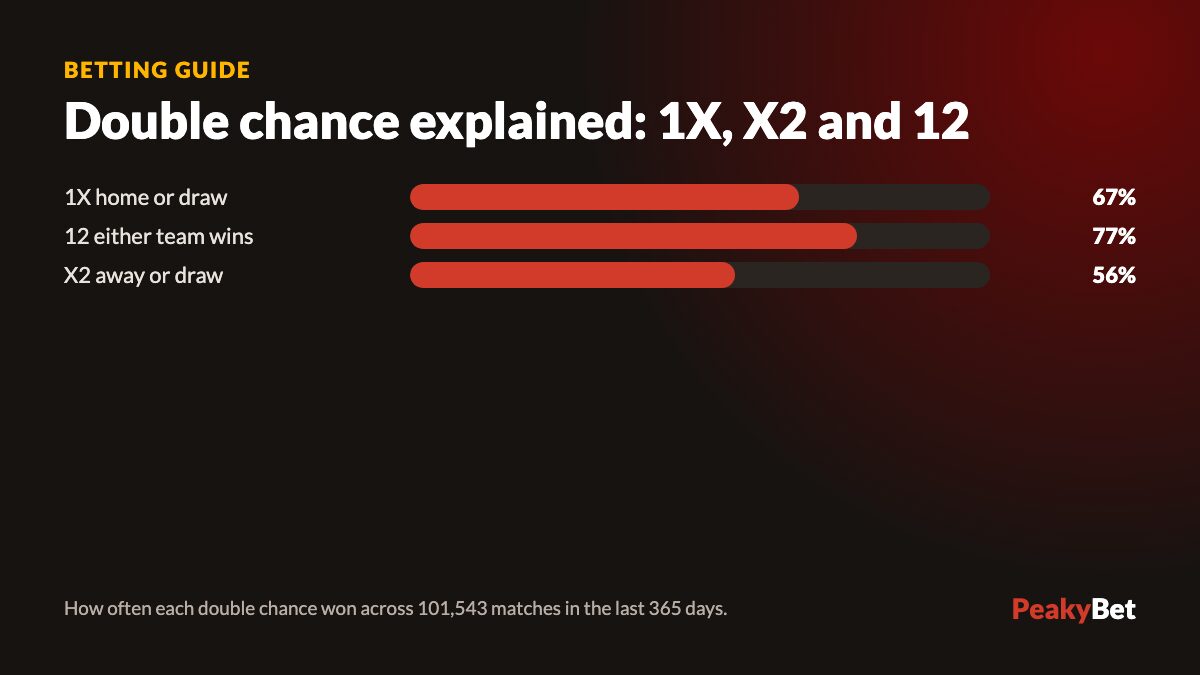
Double chance betting covers a pair of match outcomes: 1X means home win or draw, X2 means draw or away win, and 12 means either team wins. The extra cover usually comes with lower odds than a single result. Choose it when the covered outcomes fit your match view and the price makes sense.
Read 1X, X2 and 12 correctly
In a standard match result market, the choices are home win, draw and away win. Double chance combines a pair of those choices in the same selection. With 1X, you lose if the away team wins. With X2, you lose if the home team wins. With 12, you lose if the match ends level.
The label 12 can be easy to misread. It does not mean a score prediction and it does not include the draw. Before placing a selection on your phone, read the market name as well as the teams. Check the stated settlement period in the market rules, especially for cup games where extra time may be possible.
Start with the broad home, draw and away rates
Across the completed matches in PeakyBet’s last 365 days of data, home wins account for 44%, draws for 23% and away wins for 33%. These are broad historical base rates. They describe a mixed set of fixtures. They do not give the probability of a specific match you are viewing today.
The figures show why the draw needs attention. It is a normal result, not an unusual event to ignore when a favourite looks appealing. At the same time, the overall home rate is not a reason to choose 1X everywhere. A weak host facing a strong visitor can differ greatly from the mixed dataset.
Use extra cover to match a clear opinion
Consider 1X when your view is that the hosts are difficult to beat, but a home win alone looks uncertain. Consider X2 when you expect the visitors to stay competitive and a draw seems plausible. Consider 12 when you expect a winner but have trouble separating the teams. Each choice still leaves a possible losing outcome.
The double chance predictions can help you compare selections. Read the suggested cover carefully. Then ask which excluded outcome would make the bet lose, and whether you have a solid reason to discount it. If your answer depends mainly on hope, leave the match alone.
Compare the cover with the odds you receive
Extra cover usually reduces the available return for the same stake. That trade-off is central to this market. A selection can look likely to win while still offering a poor price. Think about the return alongside the chance of losing, instead of treating a short price as proof that the bet is sensible.
Compare the single-result market and the related double chance market for the same fixture. Ask what uncertainty the extra cover addresses. If your only concern is a draw, a cover that excludes the draw would not solve it. If you think the opponent can win comfortably, adding draw cover may not address your main risk either.
Understand the probability filters on PeakyBet
PeakyBet’s model uses Poisson expected goals based on season averages and the latest 5 matches. Its estimate is mixed 50/50 with bookmaker odds after the margin is removed. This is a forecast method, not a report of what has already happened. The inputs can point towards an outcome that still fails on the day.
The filtered match predictions page selects straight wins with an estimated probability of at least 60%, or double chance picks at least 80%. Those thresholds explain how selections reach the page. They are not observed success rates and they do not promise a return. The page name should never replace a careful reading of the risk.
Avoid turning short odds into a large slip
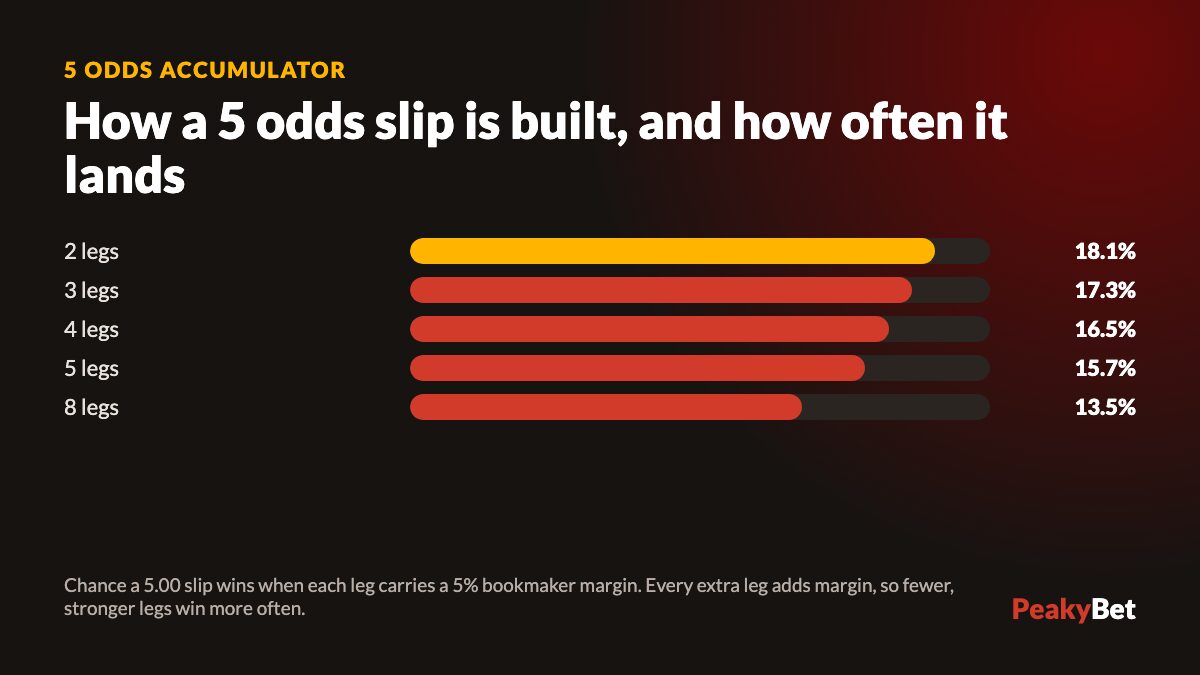
It may be tempting to combine many double chance selections because each looks comfortable. But every added match creates another way for the whole accumulator to lose. Cover within a fixture does not protect you from a failed selection elsewhere. Review the combined slip as a fresh risk, rather than as a list of reassuring prices.
Keep a simple note of the market, the odds shown when you placed it and your reason for choosing the cover. After settlement, look at whether your reasoning was consistent. Pay attention to the losing outcome you left uncovered. This helps you see if you repeatedly underestimate strong visitors, weak hosts or matches that can end level.
Keep double chance within an affordable budget
Betting is for adults aged 18+ only. Stake only money you can afford to lose. Double chance still carries financial risk, even when the odds are short. Keep essential spending separate, and avoid increasing your stake because a previous selection lost.
You can decide that the available price is too low, the match evidence is unclear or the market wording is confusing. Each is a valid reason to pass. A useful betting explanation should make the decision easier to understand. It should never make you feel that you must place a bet.
Frequently asked questions
Is double chance the same as draw no bet?
No. They are different markets with different settlement terms. Double chance can include the draw as a winning outcome, while draw no bet normally returns the stake for a draw.
Does double chance cover a specific winning margin?
No. The selection concerns the match outcome rather than the winning margin. Read the market label carefully, as handicap markets use different conditions and should not be confused with double chance.
Can I cancel a double chance selection after placing it?
Do not assume you can cancel it. Check the betting service’s terms before submitting, since cancellation or cash-out options may be restricted, unavailable or offered at an unfavourable amount.