
Whenever we open a new sportsbook for the first time, the same question keeps cropping up: what are the different types of betting odds, and why does the same Premier League fixture look so wildly different in London than it does in Sydney, Jakarta, or New York?
The numbers might read 2.00, +100, 1/1, or 1.00 depending on the screen, yet behind the curtain they are all pointing at the same probability. Different formats, identical math.
Six odds formats dominate sportsbooks worldwide. Decimal, fractional, and American handle the bulk of global volume across football, racing, and US sports. The other three — Hong Kong, Malay, and Indonesian — are built for the Asian high-roller scene and quietly run a lot of the sharpest lines on the market.
Let's lay out the side-by-side picture first so the formats stop feeling foreign, then unpack each one with worked examples on football fixtures, racing markets, and the two-way prices we see every day at any sportsbook.
The Three Main Odds Formats at a Glance
Almost every sportsbook on the planet defaults to one of three displays: decimal (the global workhorse for football and international markets), fractional (the British and Irish racing tradition), or American (the moneyline standard at US-facing books). Each format solves a different reader's problem — quick mental math, payout transparency, or stake-to-profit clarity.
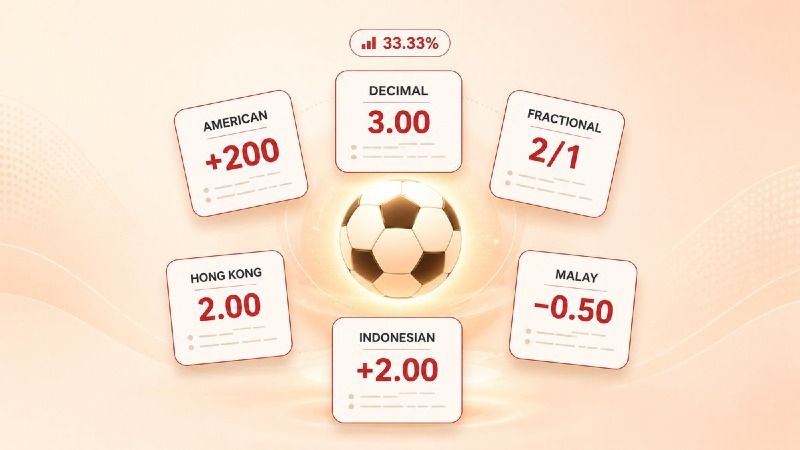
Before we drill into any single format, here is what the same two-to-one wager looks like across all six conventions, plus the implied probability that anchors them together.

| Same wager | American | Decimal | Fractional | Hong Kong | Indonesian | Malay |
|---|---|---|---|---|---|---|
| Underdog (33.33% implied) | +200 | 3.00 | 2/1 | 2.00 | +2.00 | -0.50 |
| Favorite (52.38% implied) | -110 | 1.91 | 10/11 | 0.91 | -1.10 | +0.91 |
Same probability, six different costumes. The format displayed on our screen depends on where the sportsbook is licensed and which market the line was built for. The good news: every modern operator lets us toggle the display in account settings.
American Odds (Moneyline): The US-Facing Standard
What "+" and "−" actually mean
American odds, also called moneyline odds, run the show at every US-facing sportsbook and on many global books when we flip the display toggle. They come in two flavors split by a sign — and the sign is doing all the heavy lifting.
A plus number marks the underdog and tells us the profit we earn on a 100-unit stake. A minus number marks the favorite and tells us how much we need to risk to win 100 units.
Worked through real wagers it clicks fast. A +250 line on a Copa Libertadores underdog means a 100-unit stake returns 250 in profit if they pull the upset. A -180 line on a Premier League favorite means we put 180 on the counter to walk away with 100 in profit.
The 100-unit anchor is convention, not a minimum — every sportsbook scales the math linearly to whatever stake we actually place, in pounds, euros, dollars, or any other currency the operator accepts.
The −110 standard and the built-in vig
Stare at any US-style point spread or two-way market and the odds beside it will almost always read -110 on both sides. That is not an accident: -110 is the industry-standard "juice" that lets the sportsbook keep the lights on. Both sides of a -110 market price in at 52.38% implied probability, which sums to 104.76%.
That 4.76% overage is the operator's edge, known as the vig in betting (also called juice or margin). It is the single most important number to understand before placing any wager, because it is the difference between true odds and the odds we are actually offered.
Where we'll see American odds
American odds are the default at every regulated US book and at most Canadian operators serving North American markets. They also surface on global books like Bet365, William Hill, or Stake whenever we toggle into the American display, and they appear on prop markets worldwide because the +/− format reads cleanly on long-tail player props.
Decimal Odds: The Global Default
The simplest payout math anywhere
Decimal odds win on transparency and they are the format most football bettors will see by default. The number we see is the total return per unit staked, stake included. The formula is brutally simple: total return equals stake multiplied by the decimal value. No flipping signs, no mental fractions, no fixed anchor.
Put €100 on a side priced at 2.50 and the return is €250 — that is €150 in profit plus the €100 stake. The cleanest identity to remember: decimal odds explained as fractional odds plus one, so a 5/1 longshot reads as 6.00 in decimal and a 1/5 odds-on favorite reads as 1.20.
Why exchanges and accumulators love decimals
Accumulator math is where decimals show off. Combining three legs at 2.00 each is a single multiplication — 2.00 × 2.00 × 2.00 = 8.00 — and the result is the decimal payout for the full ticket. Fractional and American formats demand conversion before the same calculation works.
Betting exchanges like Betfair and Smarkets standardize on decimals for the same reason: traders need to price the reciprocal of probability instantly, and decimal odds are literally one divided by implied probability.
Geographic footprint
Decimal odds rule continental Europe, Australia, New Zealand, Latin America, parts of Asia, and most international football markets. They are the global toggle at Bet365, Pinnacle, William Hill, and almost every operator outside the United States — the moment we flip a sportsbook out of American display, decimal is usually what appears.
Fractional Odds: The British Classic
Reading the slash
Fractional odds, sometimes called British or traditional odds, display as a ratio: 5/1, 10/11, 9/4. The number on the left is the profit, the number on the right is the stake. So 5/1 means we win five units of profit for every one unit staked, plus the stake comes back.
Real numbers make it stick. Put £20 on a 5/1 underdog and a winning ticket pays out £120 — that is £100 in profit plus the £20 stake. Reverse it for an odds-on favorite like 1/5, where £20 staked returns just £4 in profit plus the stake, totalling £24.
Why horse racing still leads with fractions
Walk into Cheltenham, Royal Ascot, or any UK high street bookmaker and the boards still glow with fractions because tradition runs deep. The Tote, ITV Racing, and the Racing Post quote starting prices fractionally as the default convention, and changing it would break decades of muscle memory in the punting community.
The other reason: fractional odds breakdown reads intuitively for racing's classic shape — favorites priced as 4/6 or 5/4, longshots as 12/1 or 33/1. The format mirrors how oddsmakers think about closing lines on the rail.
Tricky non-standard fractions
Where fractions get awkward is in the messy ratios sportsbooks use for short-priced favorites. Odds like 10/11, 9/4, or 13/8 do not reduce cleanly, and most bettors mentally convert them to decimal to compare value across books. A handy shortcut: divide the left number by the right and add one to get the decimal equivalent.
Asian Formats: Hong Kong, Malay, and Indonesian Odds
Asian sportsbooks built their odds conventions around the high-roller markets that dominate trading in Hong Kong, Singapore, Manila, and Jakarta. The formats look strange at first glance but they are tighter, faster to read, and quietly used by sharp bettors worldwide who shop Pinnacle and SBOBET for lower vig.
Hong Kong odds
Hong Kong odds, often abbreviated as HK odds, display as a decimal without the stake. They show pure profit per unit staked. The conversion is one of the simplest in betting: HK odds equal decimal odds minus one. So a 2.50 decimal price reads as 1.50 in Hong Kong format.
Worked through real money it lines up cleanly. Put $100 on a side priced at 1.50 HK and a winning ticket pays $150 in profit, plus the $100 stake returns for a $250 total. Same payout as 2.50 decimal — only the display strips out the stake portion.
Indonesian odds
Indonesian odds look like a decimal with an American-style plus or minus sign. Positive Indonesian odds work exactly like Hong Kong odds (and decimal minus one), while negative Indonesian odds work like American moneyline odds scaled down by 100.
The conversions click into place once we anchor them. Indonesian +2.00 equals HK 2.00, decimal 3.00, and American +200 — all the same underdog with 33.33% implied probability. Indonesian -1.50 equals American -150 roughly, meaning we stake 1.50 units to win 1 unit of profit on a favorite.
Malay odds
Malay odds, sometimes labelled Malaysian odds at Asian operators, are the bounded format — the value always sits between -1.00 and +1.00, and the sign convention is the mirror image of American odds. In Malay, a plus sign marks the favorite (paying less than even money) and a minus sign marks the underdog (paying more than even money).
A +0.75 Malay line is a favorite returning 0.75 units of profit per 1 unit staked, which equals 1.75 in decimal. A -0.25 Malay line is an underdog where 0.25 units staked wins 1 unit of profit, equivalent to 5.00 in decimal.
Pin that sign flip firmly in mind — it is the single most common mistake bettors make the first time they open a Malay-format ticket, especially anyone arriving from American or Indonesian conventions where the signs do the opposite job.
Implied Probability: The Number Behind Every Format
Every set of odds, regardless of format, encodes a percentage chance the sportsbook is offering. Decode that probability and we can compare lines apples-to-apples across American, decimal, fractional, and the three Asian formats. It is the universal translator that makes shopping for value possible.
| Format | Convert to implied probability |
|---|---|
| American (positive) | 100 ÷ (odds + 100) × 100 |
| American (negative) | |odds| ÷ (|odds| + 100) × 100 |
| Decimal | 1 ÷ decimal × 100 |
| Fractional | denominator ÷ (denominator + numerator) × 100 |
Why probabilities add to more than 100%
Take any two-way market priced at -110 on both sides. Each side converts to 52.38% implied probability, and the two add up to 104.76%. The extra 4.76% is the sportsbook's margin baked into the line — the same vig we covered in the American odds section.
Sharp bettors strip that margin out using an implied probability calculator to find the "no-vig" or "true odds" before deciding whether a line offers genuine value. A bet has positive expected value only when our own probability estimate is higher than the no-vig implied probability the market is showing.

Master Conversion Cheat Sheet
One wager, six wardrobes. Here is what a standard -125 American line looks like in every format we have covered, plus the implied probability the market is selling.
| Format | Display | What it means |
|---|---|---|
| American | -125 | Stake $125 to win $100 |
| Decimal | 1.80 | $1 stake returns $1.80 total |
| Fractional | 4/5 | Win £4 for every £5 staked |
| Hong Kong | 0.80 | Win 0.80 units per unit staked |
| Indonesian | -1.25 | Need 1.25 units to win 1 unit |
| Malay | +0.80 | Win 0.80 per 1 staked (favorite) |
| Implied probability | 55.56% | Market says this hits 55.56% of the time |
Memorising this single anchor line saves us hours over a betting career. Whenever a format puzzles us at a new sportsbook, we can pull up a betting odds converter and plug the value in to translate back to whatever display feels native.
Which Odds Format Should We Use?
There is no objectively best format — only the one that matches the market we are playing and the math our brain runs fastest. The right answer depends on the sport, the sportsbook, and how often we need to compare lines across operators.

For most football bettors and anyone playing global markets, decimal odds are the default and the easiest to scan. Multiplying three accumulator legs at 2.00 to get an 8.00 combined payout takes one second, and almost every international operator quotes prices this way out of the box.
For US sports fans betting on NFL, NBA, MLB, or NHL — or anyone using a US-facing sportsbook — American odds are the obvious starting point. Every regulated US book defaults to them, and the +/− shorthand makes spotting favorites and underdogs instant once the sign convention sticks.
For horse racing fans, fractional odds are not optional — they are the only display the UK and Irish racing industry will quote, from Cheltenham to Royal Ascot. Decimal toggles exist on most racing apps, but the tradition runs deep enough that learning to read fractions pays off.
For sharp bettors hunting low margins on Asian handicap markets at Pinnacle, SBOBET, or 1xBet, Hong Kong or Indonesian formats become the operational currency. The lines are tighter, the limits are higher, and the format mirrors how the traders themselves think about price.
Frequently Asked Questions
What are the different types of betting odds?
Six odds formats dominate sportsbooks worldwide: American (moneyline), decimal (European), fractional (British), Hong Kong, Indonesian, and Malay. The first three handle most global volume; the three Asian formats run high-roller and sharp-bettor markets. All six describe the same underlying probability — the only difference is how the number is displayed and whether the stake is included in the payout figure.
What do +200 odds mean?
+200 American odds mean a 100-unit stake wins 200 in profit, returning 300 total including the stake. The plus sign always marks the underdog, and the number is the profit on a 100-unit anchor wager.
In implied probability, +200 reads as 33.33% — the sportsbook is pricing this outcome to hit roughly one time in three. The same line shows as 3.00 in decimal odds and 2/1 in fractional, so we can compare against other operators using whichever format we read fastest.
What does the +/− mean in betting odds?
In American odds, a plus sign marks the underdog and shows the profit on a 100-unit stake, while a minus sign marks the favorite and shows the stake required to win 100 units.
Malay odds use the opposite convention — plus is the favorite and minus is the underdog. Indonesian odds follow the American sign convention but display values as decimals scaled by 100.
Why are betting odds negative?
Negative odds signal the favorite — the side the sportsbook expects to win more than 50% of the time. Because the implied probability is above 50%, we must risk more than we stand to profit. A -180 line, for example, requires a 180-unit stake to win 100 units, reflecting a 64.29% implied probability that the favored outcome lands.
Which odds format pays out the most?
None of them. All six formats encode identical payouts for the same probability — only the display differs. A +200 American line, 3.00 decimal line, 2/1 fractional line, 2.00 Hong Kong line, +2.00 Indonesian line, and -0.50 Malay line all pay exactly the same on a winning wager. The "biggest payout" appearance is a display artifact, not a real edge.